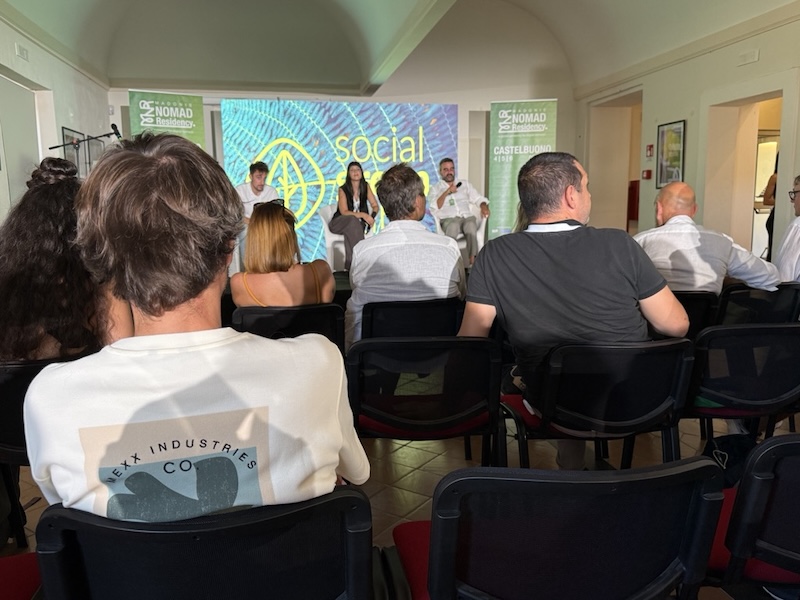
A speaker at the event used a metaphor that stayed with me:
"A feather and a swallow. The feather goes where the wind pushes it. The swallow decides where it is going."
More like a feather carried by the wind, that is how I ended up in Sicily, in Castelbuono to be precise. It is serendipitous how I heard of this event: it was through a Bansko connection, Alex Enache, who is a close friend and valued community member in Bansko. He told me that he liked to introduce me to the people behind Madonie and Castelbuono… this is how things usually fall into place when you are part of an ecosystem that is lively, such as the digital nomad community in Bansko.
I took the chance to connect with Paola who is part of the organiser-team at madonienomads.com and it seems we immediately clicked, and she invited me to come to join the event.
Flying to Sicily is easy from Sofia, a direct flight by Wizz Air, and ultimately we were a group of three people heading to Castelbuono together. The people were aces — everything was planned and organised for us and ahead of time. Our driver waited already when we arrived. It was late in the day and we did not see much in the dark when we drove along the coastline of north Sicily, that is the price you pay for late arrivals.
The next day, when we got to know the place, we were all surprised to learn that Castelbuono has a lively public coworking space that has been running for 5 years. We thought that was a very good sign and a great start.
Why did I join the event?
I am curious, and my efforts are to support the nomad community at large. For me, the entire journey started in 2016, when we arrived in Bansko the first time. Over the years, we transferred a small mountain ski town into a lively year-round nomad hotspot and created a large digital nomad community that either settled in Bansko, bought apartments and/or established a base, or at the very least returns each year to Bansko.
Speaker slots, unfortunately, had already been filled when I learned about the event, but due to my work and sharing the Bansko Blueprint the team invited me in a heartbeat.
I came with two questions:
- What makes a place attractive for nomads?
- What can the team behind Madonie do to establish a self-sustaining hub?
Credit where credit is due
Let me say this first, because it is true. As a first event, the Madonie Nomad Residency was good. The initiative is real, the passion of the people driving it is real, the willingness is real. The organisers brought international speakers, regional institutions, and a program that filled three days and entertained the visitors. The town showed up and attracted people from all over Italy and beyond.
And the foundation already exists: Social Green Hub, the public coworking space in the compound of the Museo, has been alive for about five years. Its founders — young Sicilians who returned home during the pandemic — built something rare: a nonprofit coworking in an 8,000-person town that has logged roughly 250 users, welcomed companies for team weeks, and — this is the part I loved — seen two Canadian nomad couples stop travelling, settle here, and buy houses. Their own estimate puts the local economic impact at around €500.000 over three and a half years. That is a seed that sprouted.
The program for each day started in the afternoon at 15:00 and finished late at 20:00 with DJ and live music, finger food and drinks after the program — la dolce vita!
About Castelbuono
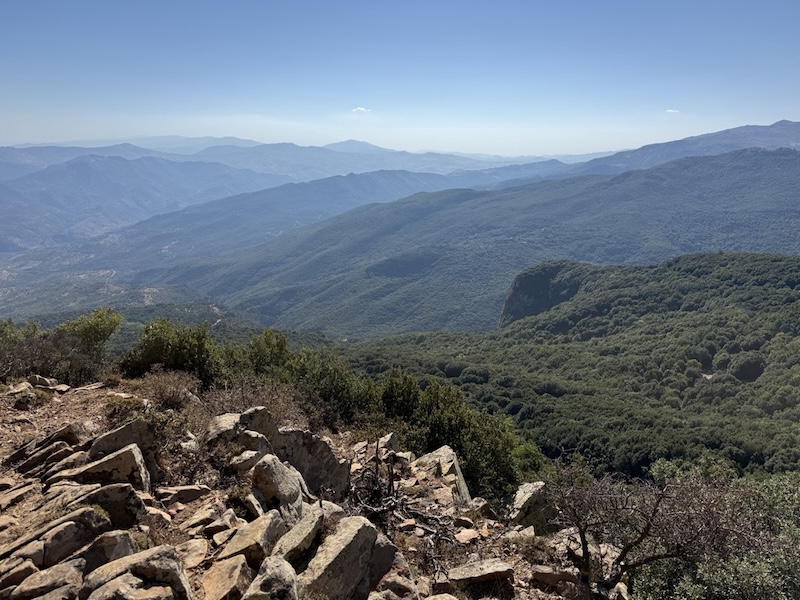
This particular area and surrounding is rural. It is 1 hour 45 minutes from Palermo by car. It has this typical Italian little-town vibe — small streets, lots of Fiat Pandas and similar Italian cars. Fantastic restaurants to eat out and big supermarkets that cater for almost all your needs. The place is as good as any, plus it offers the fantastic charm of an Italian culture that we all love. The food is excellent. The southern Italian culture is friendly, warm, and has a great charm.
The ocean and the mountains are half an hour apart. A castle in the middle of town. If attracting people were only about the setting, Castelbuono has won already! Consider good food and amazing people and you can easily see that nomads will love it here.
For whom was this event, actually?
The event page read "Who it's for" and listed: digital nomads, remote workers, founders and startups, freelancers, and more. In reality, the content was more tailored to the institutions, to collaborators, and people in positions with access to funding and/or government support. There were only a handful of nomads, and despite them liking the event, it was not the core audience, and the value certainly was not aimed at digital nomads.
But then, as we discussed in the group that formed over the weekend, and since we had a researcher amongst us, we have to discuss the terminology… or is it rather the lack thereof? What is a nomad (digital nomad)? There is no one right answer. Is an Italian who works remotely and travels in Italy and is registered in Italy a digital nomad? I certainly have an opinion on whom to call a nomad and who not to call that. In any case, the house was full, and many people came to the event — it was great to see so many attendees joining.
There was a gap I would like to address. As a non-Italian native with only very little knowledge of the language, I had trouble following most of the talks and sessions, as they were held in Italian. This is a real gap when aiming for an international audience. A translation app helped, but it lagged and sometimes did not work very well.
Regardless, I am certain the event was a first success for the organisers, the speakers, and most of the attendees alike. And for the town too, I think. The event felt like an affirmation or rather a manifestation of what is to come. Basically, it was the initial spark to align the people and their efforts before the project takes off. Seeing it this way makes sense, but then the question is: how to follow up?
Though the format seemed to work for most attendees, I would describe it as: frontal conference style, one speaker (or panel) after another, rows of chairs. All very well planned out.
Nomads, on the other hand, need a different style, a different format. They need to be baked into the program, and the international touch was missing — for instance, the language gap. The follow-up could have been an announcement of the next event. It felt like a missed opportunity to pitch that to the audience already there.
So who was it really for? Probably the general public. People who want to run the same event in other regions. The municipality and the money-givers. For that audience, it was good. For the end-users, the nomads, as per the website, it was not. As a first "info" event showing the interest, the passion, and the possible impact — yes, absolutely. A nomad event? No, not really, at least not yet.
The infrastructure reality
Let me be concrete, because nomads are a practical species. Based on what I saw and heard in Castelbuono:
- Coworking: exists — Social Green Hub. Real, alive, affordable (a €20/year card), community-run.
- Coliving: missing. Nothing resembling nomad coliving or monthly-lease housing was on offer. A nomad's first week here has no obvious answer to "where do I sleep for a month?"
- Connectivity: this is where it bites. Wi-Fi speeds are low in places, and 4G/5G depends heavily on where you stand. For people whose entire livelihood is a video call, this is not a nice-to-have.
- Nomad-adapted services: scooter rental, long-term bike hire, the small ecosystem of conveniences a location-independent person expects — not there yet.
None of this is fatal. All of it is fixable. But it tells you the truth: the place is as good as any, and the equipment is not ready for the guests just yet.
The lesson from Bansko
Here is the thing I know best, because I started and nurtured the project and watched it happen.
The coworking came first there too! Coworking Bansko started in 2016. It took about three years to attract a larger number of nomads, and during that time it ran a steady rhythm of events and meetups, talks, ski days, community dinners, hot springs visits and many more. The community was slowly assembled by my co-founder and me, and we created a rhythm and invited everyone to join us.
Castelbuono, for now, has the right ingredients, and now it needs the right recipe to combine them in a useful manner.
Gonçalo Hall put it nicely: "nomads are not travelling to destinations, they travel to communities". He built Madeira and many other nomad places, and as one of the speakers, he stood out with his expertise in setting up nomad villages. I agree, and to put it more formally, in my own words, I call it "The Community Ikigai" — the centre of five pillars around it where nomads want to hang out: community focus, a key person (a curator who lives there and holds the community together), events (regular, year-round, not annual), partnerships, and infrastructure.
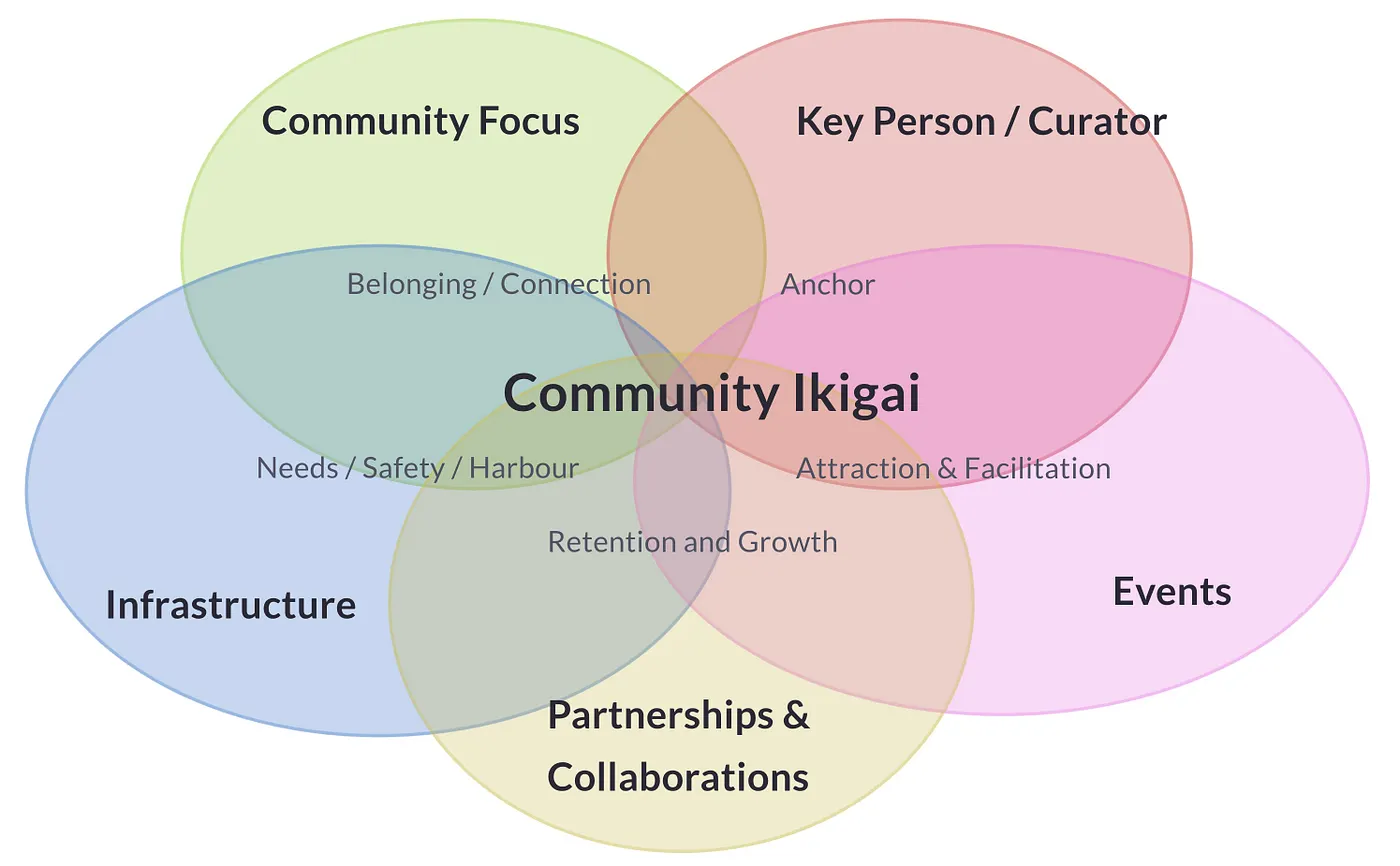
The story repeats, and it is what happens when all five line up, and it can happen in Castelbuono too! The same as it did in Ponta do Sol, or Bansko, or elsewhere.
To answer the previous question: how to follow up?
I have followed many community projects over the years, and many followed this pattern: you build the attraction, the crowd comes, and all the surrounding establishments — the hotels and the bars — earn the money. The project itself generates nothing that sustains it. When the funding dries up, it dies. The attraction was real but the business underneath was not.
My experience in real estate investment, and through my projects Orbelus Bansko and Bansko Mountain Homes, gives me a good understanding of catering for this particular niche. My effort is to enable and collaborate with community builders, in order to design win-win-win based nomad and coliving hubs, as well as community projects around the globe. The goal is to craft and plan projects that are self-sustaining and create value for all stakeholders, so that they can function and survive even after the initial funding dries up.
To build long-term success it is essential to focus on a basis that allows the project to continue after the funding disappears. Usually that means ownership: owning the premises, owning the place, and forming the community around it. It is best to sharpen the plan until the win-win-win case is fully encapsulated and allows the project to function as a business, or as an NGO.
Events, one of the pillars mentioned, are very important as a form of attraction. Standard conferences are not what the nomad scene wants — it does not work that way. The value must go to the attendees; nomads need unconferences, and a program that allows collaboration and creates a sense of belonging. We need the interaction, the being part of the event. Frontal talks — one speaker without attendee interaction — need to mix with workshops and unconferences so the audience becomes part of the event. Nomad events need a format that fosters the community aspect: unconference, peer-to-peer or interactive sessions, people in circles, health-related aspects, sports and alike. It is the difference between an event for nomads and an event about them.
To be fair, Tony Cirnigliaro, executive director of Empeeria, sees it the same way, noting that any lasting project needs to add value for every stakeholder involved. I agree. The question is whether the machinery gets built to make it true: revenue flowing to the hub and the community, skills flowing back to locals, coliving that pays its way, a curator whose salary doesn't depend on the next grant. Win-win-win as accounting, not as a slogan.
What Castelbuono can do
If I were advising the next edition, this is what I would put on the table:
- Rebuild the program for the avatars. Unconferences, coworking sprints, peer-to-peer sessions. Co-design the program with people who have lived the life. Less podium, more circles.
- Follow up and grow the community before the next event. A key person living in Castelbuono. Offer meetups at Social Green Hub that attract outsiders and share what you are doing publicly and loudly. A coliving operator — the model Marco from Palermo is already running — can be the guiding light for Castelbuono.
- Fix the practical stack. Coliving units, monthly leases, published and honest connectivity tests, scooter and transport options. Small things. Decisive things.
- Wire the win-win-win into the mechanics. A skills give-back from every visiting nomad to local youth and businesses. Revenue capture for the hub. Contracts with local suppliers. Make it structurally impossible for the town's bars to be the only winners.
Swallow or feather?
But a feather is not a bird. The wind can carry it beautifully, and it can drop it anywhere. The swallow decides its goal, builds a nest, and comes back every year. The question Castelbuono now faces is the one from the festival itself: can the team manage to attract nomads and build a foundation to reach the critical mass needed to establish a nomad hub, or will they be carried off by the wind like a feather?
For one, I would love to help build the nest.
With best regards,
Uwe
Sources
- Madonie Nomad Residency — program and "who it's for"
- TGcom24 — Social Green Hub interview with the founders
- Regione Siciliana — South Working incentive platform (IRFIS)
- ANCE Catania — South Working, €18M/year 2026–2028
- StartUp Magazine — Madonie Nomad Residency launch, organisers and Smart Land
- BeSicilyMag — the itinerant format across Madonie municipalities
- Patto per Restare — the right-to-stay movement
- The Bansko Blueprint — Community Ikigai and the Bansko story